Market Trends2026/8/4
What's the difference between cleanroom prepainted coil and standard prepainted coil? Must-read guide for selecting materials in cleanrooms.
Purified Color-Coiled Steel is a specialized raw material for cleanroom construction. Compared to standard color-coated coils, it features significant differences in coating quality, surface roughness, dust resistance, antimicrobial properties, and disinfectant durability. This article details the core distinctions between the two to guide accurate material selection for pharmaceutical, electronics, and food-grade purification projects.
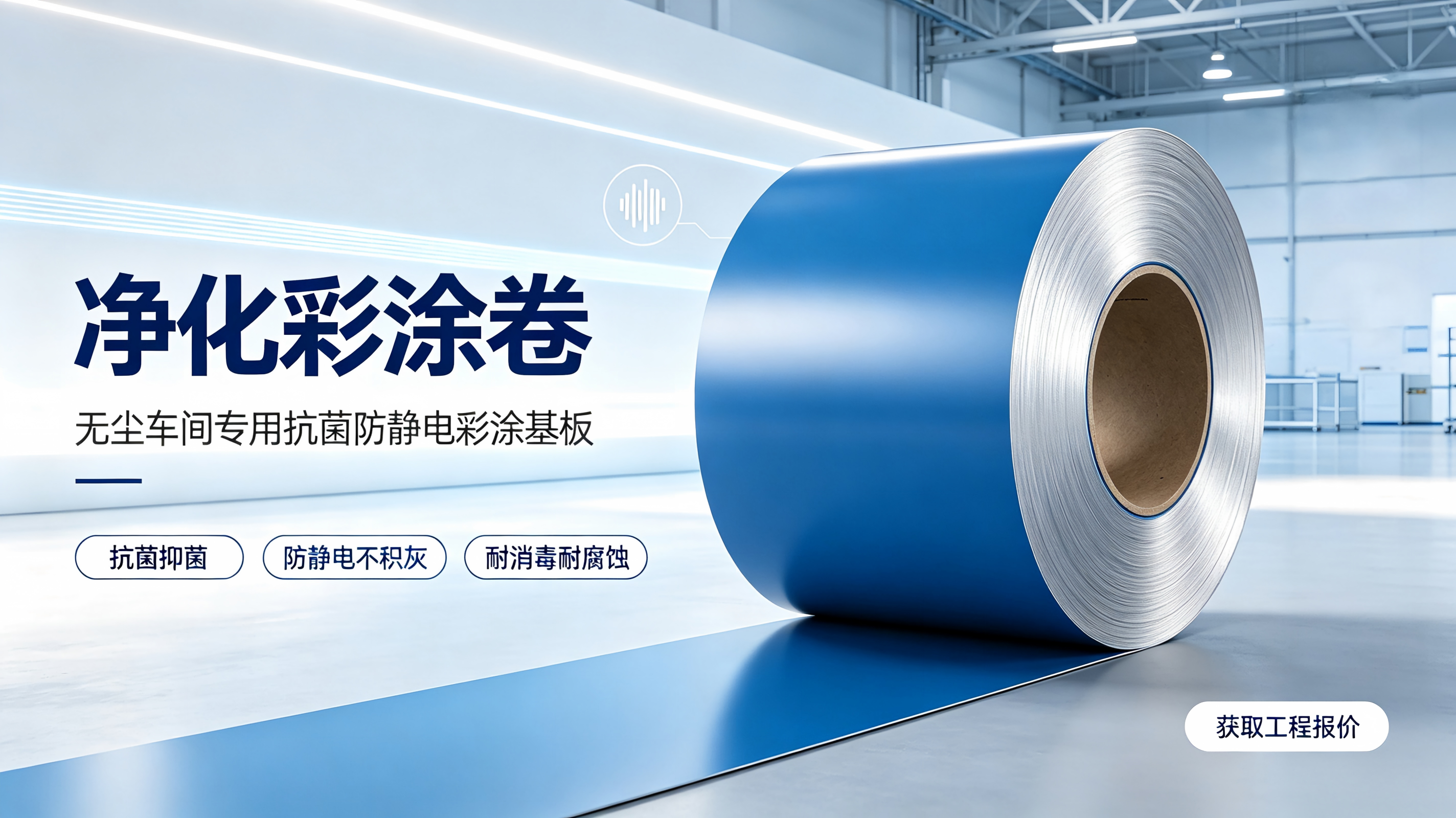
<p>What is the difference between Purified Color-Coiled Steel and Standard Color-Coiled Steel?</p><p>Many clients in cleanroom engineering and sandwich panel production often confuse purified color-coiled steel with standard architectural color-coil. While both appear as white steel coils, their coating formulas, production processes, and performance standards are entirely different. Using standard color-coil in a cleanroom can easily lead to dust accumulation, powder shedding, bacterial growth, and electrostatic dust attraction, making it impossible to pass GMP cleanroom acceptance. Below is a comprehensive analysis of the core differences.</p><p><strong>1. Core Definitions</strong></p><p><strong>Purified Color-Coiled Steel (Cleanroom-Specific)</strong></p><p>A functional pre-coated steel sheet specifically developed for cleanroom panels. Used as the facing material for clean sandwich panels, it is widely applied in pharmaceutical workshops, food plants, electronic无尘 workshops, laboratories, and operating rooms. Key features include zero dust generation, resistance to dust accumulation, durability against repeated disinfection, and optional anti-bacterial or anti-static properties.</p><p><strong>Standard Color-Coiled Steel (General Architectural)</strong></p><p>Traditional architectural color-coil used primarily for factory roofs, exterior walls, ordinary warehouse fencing, and simple prefabricated houses. Its core function is corrosion protection and decoration, with no requirements for cleanroom environments.</p><p><strong>2. Detailed Comparison Across Six Dimensions</strong></p><table style="min-width: 75px;"><colgroup><col style="min-width: 25px;"><col style="min-width: 25px;"><col style="min-width: 25px;"></colgroup><tbody><tr style="border-bottom-width: 1px;"><th colspan="1" rowspan="1" style="background-color: rgb(248, 248, 248); padding-inline-start: {10"><strong>Comparison Item</strong></p></th><th colspan="1" rowspan="1" style="background-color: rgb(248, 248, 248); padding-inline-start: {16"><strong>Purified Color-Coil</strong></p></th><th colspan="1" rowspan="1" style="background-color: rgb(248, 248, 248); padding-inline-start: {22"><strong>Standard Color-Coil</strong></p></th></tr><tr style="border-bottom-width: 1px;"><td colspan="1" rowspan="1" style="padding-inline-start: {26"><strong>Coating Formula</strong></p></td><td colspan="1" rowspan="1" style="padding-inline-start: {29"><strong>Cleanroom-specific topcoat:</strong> Dense coating structure with extremely low porosity; can be formulated with anti-bacterial additives and conductive anti-static components; forms a non-chalking, dense film.</p></td><td colspan="1" rowspan="1" style="padding-inline-start: {32"><strong>Standard PE polyester topcoat:</strong> Basic corrosion protection and decoration only; micro-pores exist in the coating; no anti-bacterial or anti-static design.</p></td></tr><tr style="border-bottom-width: 1px;"><td colspan="1" rowspan="1" style="padding-inline-start: {36"><strong>Surface Micro-Characteristics</strong></p></td><td colspan="1" rowspan="1" style="padding-inline-start: {39"><strong>Surface roughness Ra ≤ 0.6μm:</strong> Mirror-smooth surface prevents dust adhesion; wipes without powder shedding; generates no particulate matter itself.</p></td><td colspan="1" rowspan="1" style="padding-inline-start: {43"><strong>Higher surface roughness:</strong> Microscopic凹凸 structures trap dust; frequent wiping with disinfectants causes coating aging and slight powder shedding over time.</p></td></tr><tr style="border-bottom-width: 1px;"><td colspan="1" rowspan="1" style="padding-inline-start: {47"><strong>Chemical Resistance</strong></p></td><td colspan="1" rowspan="1" style="padding-inline-start: {50"><strong>Resists repeated scrubbing</strong> with sodium hypochlorite, hydrogen peroxide, alcohol, and other disinfectants without whitening or corrosion.</p></td><td colspan="1" rowspan="1" style="padding-inline-start: {53"><strong>Poor resistance to high-frequency chemical disinfection:</strong> Long-term use of disinfectants leads to loss of gloss and coating corrosion.</p></td></tr><tr style="border-bottom-width: 1px;"><td colspan="1" rowspan="1" style="padding-inline-start: {57"><strong>Optional Functional Attributes</strong></p></td><td colspan="1" rowspan="1" style="padding-inline-start: {60"><strong>Two functional versions available:</strong> Anti-bacterial and Anti-static purified coils. Anti-static version has a surface resistivity of 10⁶~10⁹Ω to eliminate static dust attraction.</p></td><td colspan="1" rowspan="1" style="padding-inline-start: {65"><strong>No native anti-bacterial or anti-static properties;</strong> standard color-coil cannot be retrofitted to meet cleanroom anti-static standards.</p></td></tr><tr style="border-bottom-width: 1px;"><td colspan="1" rowspan="1" style="padding-inline-start: {69"><strong>Base Metal & Coating Requirements</strong></p></td><td colspan="1" rowspan="1" style="padding-inline-start: {72"><strong>High-zinc hot-dip galvanized / Al-Zn base metal:</strong> Strictly processed surface to minimize substrate impurity leaching.</p></td><td colspan="1" rowspan="1" style="padding-inline-start: {75"><strong>Wide range of zinc layer specifications:</strong> Cost-driven; meets basic outdoor corrosion needs only; no mandatory precision processing requirements.</p></td></tr><tr style="border-bottom-width: 1px;"><td colspan="1" rowspan="1" style="padding-inline-start: {79"><strong>Application Scenarios</strong></p></td><td colspan="1" rowspan="1" style="padding-inline-start: {82"><strong>Pharmaceutical cleanrooms, food purification plants, semiconductor无尘 workshops, hospital operating rooms, third-party laboratories.</strong></p></td><td colspan="1" rowspan="1" style="padding-inline-start: {85"><strong>Steel structure factory exterior walls/roofs, ordinary warehouses, outdoor fencing, non-clean auxiliary rooms, temporary prefabricated houses. <strong>Prohibited for high-standard clean spaces.</strong></strong></p></td></tr></tbody></table><p><strong>3. Common Selection Pitfalls</strong></p><p><strong>Misconception 1: Same Color Means Interchangeable</strong></p><p>Both purified and standard coils typically come in white/grey shades (RAL9002/RAL9010), making them visually indistinguishable. However, their internal coating systems differ completely. Using standard coil in a clean environment causes continuous particle shedding, directly impacting cleanroom certification.</p><p><strong>Misconception 2: Retrofitting Standard Coil with Anti-static Paint</strong></p><p>Applying paint later results in poor adhesion, peeling, and significant contamination. Cleanroom projects will not accept this as a substitute for native anti-static purified coils.</p><p><strong>Misconception 3: Choosing Thin-Coat Coil to Save Costs</strong></p><p>Clean environments require stable, dense films. Thin-coat coils have significantly reduced disinfection resistance, leading to surface discoloration even after short-term use.</p><p><strong>4. How to Select Materials Correctly</strong></p><p>✅ <strong>Scenarios Requiring Purified Color-Coil:</strong></p><p>Pharmaceutical production, GMP health supplement workshops, dairy/bakery purification lines, lithium battery manufacturing, chip/electronics无尘 workshops, PCR labs, hospital clean operating rooms, and恒温恒湿 storage.</p><p>✅ <strong>Scenarios Suitable for Standard Color-Coil:</strong></p><p>Standard steel factory exteriors, warehouse roofs, outdoor fencing, non-clean auxiliary buildings, and temporary prefabricated housing.</p><p><strong>5. Summary</strong></p><p>In short: Standard Color-Coil = Architectural protective/decorative material; Purified Color-Coil = Functional special steel meeting cleanroom specifications.</p><p>Cleanroom engineering is a high-standard specialized project. Wall and ceiling materials must not be downgraded or substituted. Choosing certified purified coils ensures easier third-party cleanroom testing, extends panel lifespan, and reduces long-term cleaning and renovation costs.</p><p>We stock various specifications of purified color-coils (anti-bacterial and anti-static types), including original BaoSteel and Magang cleanroom coils. Thickness ranges from 0.4~0.7mm. We support slitting and custom flat-cutting for sandwich panel manufacturers and cleanroom engineering companies. For sample testing, technical data sheets, or quotes, please contact us anytime.</p>